


Fingerprints of the Gods
Title: Fingerprints of the Gods
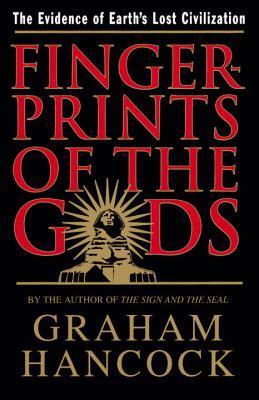
Author: Graham Hancock
Published in: 1996
Date read: 1st October 2026
Score: 4/5
Genre: Mythology, Non-fiction
Plot: (Warning, may contain spoilers):
Published in 1995, Fingerprints of the Gods is a highly influential work of alternative archaeology and pseudohistory. Rather than a fiction thriller, this is a non-fiction narrative framed like a grand detective story, traveling the globe to argue that an advanced, forgotten civilization predated all known ancient cultures.
The Central Premise:
Hancock argues that mainstream historians have it all wrong. He proposes that thousands of years before the rise of ancient Egypt, Mesopotamia, or the Incas, a highly sophisticated maritime civilization flourished.
According to his theory, this advanced society was completely wiped out around 10,500 BC by a sudden, cataclysmic global event—specifically, a massive crustal displacement that shifted Antarctica into the south polar circle, freezing the civilization's heartland instantly. The survivors of this apocalypse allegedly traveled the globe, sharing their advanced scientific, astronomical, and architectural knowledge with primitive indigenous peoples, who revered them as "gods."
The "Clues" (Evidence Gathered):
The book follows Hancock as he visits ancient ruins worldwide, pointing out anomalies that he claims are the "fingerprints" left behind by these survivors:
• Advanced Maps: He points to medieval maps, like the Piri Reis map, claiming they show an ice-free coastline of Antarctica, suggesting someone mapped the continent before it was frozen.
• The Megaliths: He explores monumental structures like Tiwanaku in Bolivia and Nazca in Peru, arguing that primitive people could not have moved such massive stones or engineered such precision without advanced geometric guidance.
• Astronomical Alignment: Hancock focuses heavily on the Giza pyramids and the Great Sphinx in Egypt. He supports the theory that the three pyramids were built to perfectly mirror the alignment of Orion’s Belt as it appeared in the night sky precisely in 10,500 BC.
• Shared Myths: He examines global flood myths—from Noah's Ark to Aztec legends—arguing they are historical memories of the massive cataclysm that ended the Ice Age.
The Scientific Reception:
While the book became a massive international bestseller and sparked deep public fascination, it was heavily rejected by mainstream archaeologists, geologists, and historians. Scholars point out that the book relies on cherry-picked data, overlooks extensive evidence of gradual human technological evolution, and misinterprets geological history.
Despite the academic skepticism, the book laid the groundwork for modern alternative history media and remains a definitive text for those captivated by the idea of a lost chapter in human history.
Comments:
Very difficult start, how do I categorise this book without upsetting somebody? Firstly, I watched the TV series on Netflix and loved it, it was so entertaining and thought provoking and I later found out that it was based on Graham Hanckcock's book. As I am writing this, I am about half way through the book and it is going well. It does help to have seen it on TV first as I can picture the amazing structures and scenery from the TV which is bringing the words to life.
When reading this, there is a particular section that feels like you are reading a mathematics textbook but proves the point. I don't care if people reading this think that I am now preparing my tin-foil hat but don't knock it until you have tried it. In science, we should always question our data, our theories and assumptions. I hope that i live long enough to see evidence for at least one of these possibilities.
Books that we've read by Graham Hancock (1):
Fingerprints of the Gods (1996)
This page was updated on: 18th July 2026